Why Your Boat Deserves Professional Polishing Care
Boat polishing near me is more than a search—it’s the first step toward protecting your investment and keeping your vessel looking showroom-ready season after season.
Quick Answer: Finding Local Boat Polishing Services
- What it is: Professional removal of oxidation, scratches, and UV damage to restore your boat’s gelcoat or paint finish
- Why it matters: Protects against sun damage, increases resale value by up to 20%, and extends your boat’s lifespan
- How often: At least twice yearly for boats on Lake Texoma or Table Rock Lake; more frequently in harsh conditions
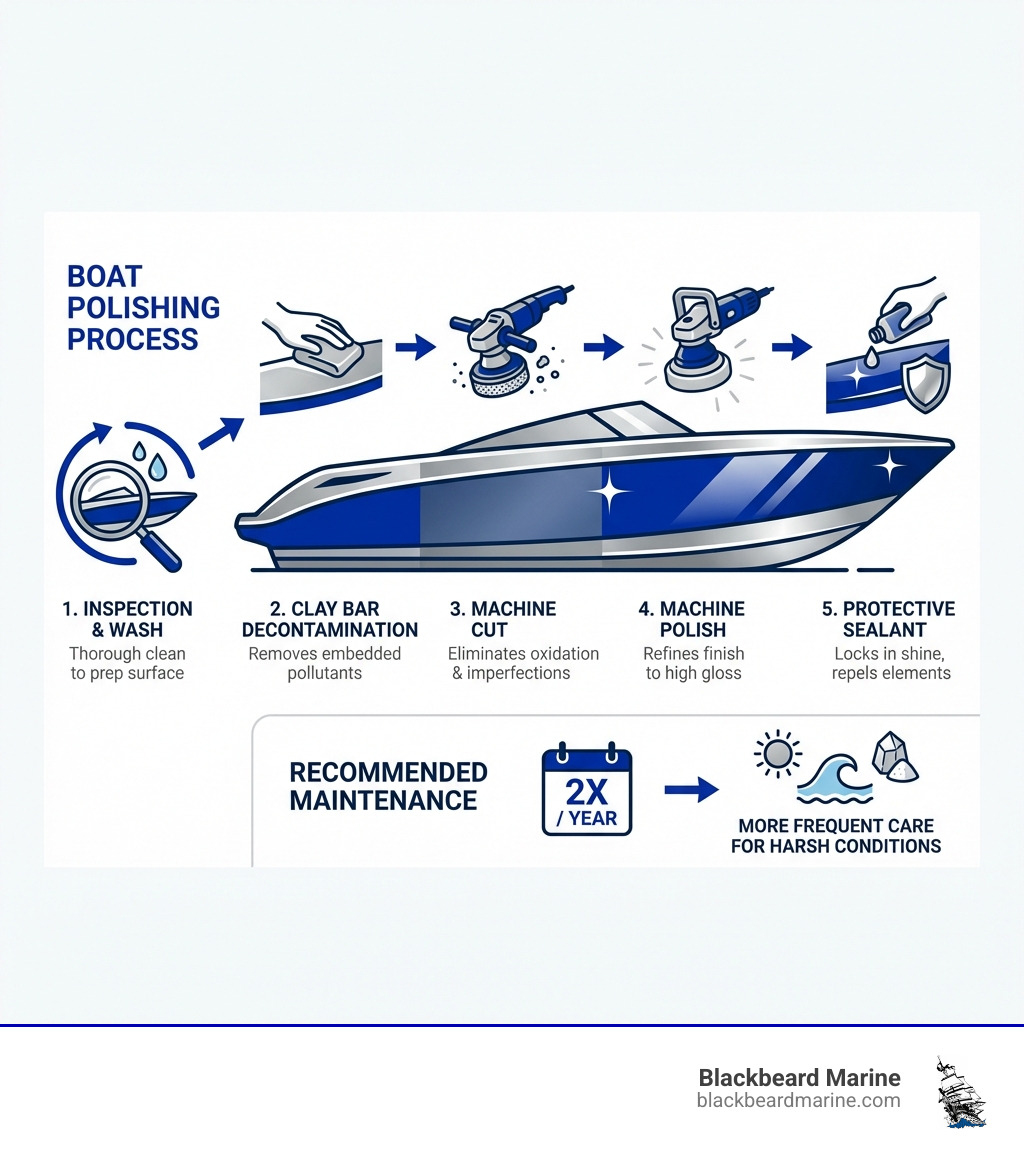
- What to expect: Deep cleaning, clay bar decontamination, machine polishing, and protective sealant application
- Where to go: Blackbeard Marine Service & Parts serves Oklahoma and Missouri boaters
Your boat faces constant assault from the sun’s UV rays, water minerals, and environmental contaminants. Whether you own a Suncatcher pontoon, a G3 fishing rig, or a Blazer Bay center console, that gorgeous finish doesn’t stay pristine on its own.
Professional boat polishing removes the chalky oxidation layer that makes gelcoat look faded and tired. It eliminates water spots, restores depth to your boat’s color, and applies protective barriers against future damage. The result? A mirror-like shine that turns heads at the marina and protects your investment for years to come.
Regular detailing can increase a boat’s resale value by up to 20%, according to marine industry data. That’s real money back in your pocket when it’s time to upgrade.
At Blackbeard Marine, we understand the unique challenges boats face in Oklahoma and Missouri waters. From the scorching summers on Lake Texoma to the seasonal storage needs near Branson, local conditions demand specialized care that keeps Suncatcher, Lowe, Seaark, Skeeter, and Blazer Bay boats performing and looking their best.
Why Professional Boat Polishing Near Me is Essential for Your Vessel
When we talk about boat polishing near me, we aren’t just talking about making things look “pretty.” Polishing is a critical maintenance step that addresses the physical health of your boat’s exterior. In the high-intensity sun of Oklahoma and Missouri, UV rays act like sandpaper on your boat’s finish. Without a polished and protected surface, your gelcoat begins to oxidize, turning that deep, rich color into a chalky, white mess.
Professional polishing involves using specialized compounds and high-speed buffers to physically level the surface of the gelcoat or paint. This process removes the microscopic “peaks and valleys” where dirt, salt, and algae love to hide. By smoothing these out, we create a surface that is not only incredibly shiny but also much easier to clean after a long weekend on Table Rock Lake.
The financial impact is just as significant as the aesthetic one. Statistics show that the global marine detailing market is projected to reach $1.5 billion by 2027, largely because owners are realizing that maintenance is cheaper than restoration. Regular detailing preserves the structural integrity of your hull materials. When you eventually decide to trade in your Skeeter for a newer model, having a documented history of professional polishing can increase your resale value by up to 20%.
If you are looking for Lake Texoma: Mobile Marine Detailing by Blackbeard Marine, you are choosing a service that understands the specific grime and mineral deposits found in our local waters. We don’t just wash; we restore.
Restoring Your Gelcoat with Boat Polishing Near Me
Gelcoat is the protective outer layer of fiberglass boats, like our Suncatcher pontoons and many of our high-performance fishing vessels. Over time, exposure to oxygen and sunlight causes a chemical reaction known as oxidation. If your boat feels rough to the touch or leaves a white, chalky residue on your hand, it’s screaming for help.
Restoring a faded gelcoat is a multi-stage process. We start by removing the “dead” layer of gelcoat to reveal the fresh, vibrant material underneath. For Lowe boats or Suncatcher models that have spent several seasons under the Kingston sun, this might require a “heavy cut” compound. This isn’t something you want to tackle with a hand towel and some elbow grease; it requires the precision of a professional to ensure the surface is leveled without being damaged.
Our Service and Parts department uses marine-grade products specifically designed for the density of gelcoat, which is much harder and more porous than automotive paint. By choosing professional boat polishing near me, you ensure that the restoration goes deep enough to last, rather than just temporarily masking the problem with a greasy wax.
Benefits of Choosing Expert Boat Polishing Near Me
We often hear from boaters who tried the DIY route only to find themselves exhausted, sore, and staring at a boat full of “buffer trails” or swirl marks. Professional boat polishing is a labor-intensive craft. Our expert technicians at Blackbeard Marine have spent hundreds of hours mastering the art of the high-speed buffer.
The benefits of going pro include:
- Time-Saving: Instead of spending your entire Saturday scrubbing in a hot driveway, you can drop your boat off with us and spend your time planning your next trip to Branson.
- Professional Tools: We use variable-speed rotary polishers and dual-action buffers that provide a level of heat and friction control simply not available in consumer-grade hardware.
- Marine-Grade Compounds: We use specialized products like 3M Perfect-It and other industry-leading compounds that are engineered to handle the unique chemistry of marine gelcoats and aluminum.
- Consistency: We ensure every inch of your Seaark or Blazer Bay—from the waterline to the gunnels—receives the same meticulous attention.
The Professional Process: From Oxidation to High-Gloss Shine
What actually happens when you book boat polishing near me at Blackbeard Marine? It’s a systematic approach that ensures no step is skipped. We treat every G3 aluminum fishing boat or Lowe pontoon with the same level of care.
- Decontamination: We start with a thorough wash using pH-neutral, eco-friendly soaps to remove loose dirt and salt.
- Clay Bar Treatment: Just like on a high-end car, a clay bar is used to pull embedded contaminants out of the pores of the gelcoat. This ensures we are polishing the boat itself, not the dirt stuck to it.
- Machine Cutting: This is where the heavy lifting happens. Using a wool pad and a cutting compound, we remove the oxidation and fine scratches.
- Surface Refinement: We switch to a softer foam pad and a finer polish to remove any remaining haze and bring out that deep, “wet look” shine.
- Protection: Finally, we seal all that hard work with a high-quality wax, polymer sealant, or ceramic coating.
Polishing vs. Waxing: What’s the Difference?
It’s a common misconception that polishing and waxing are the same thing. They are actually two different steps in the detailing lifecycle.
| Feature | Polishing | Waxing |
|---|---|---|
| Primary Purpose | Restores shine and removes defects | Provides a protective barrier |
| Action | Abrasive (levels the surface) | Non-abrasive (fills the surface) |
| Removes Oxidation? | Yes | No (it just covers it up) |
| Frequency | 1-2 times per year | Every 3-4 months |
| Effect on Finish | Creates the “mirror” look | Adds depth and slickness |
Specialized Care for Metal and Paint
Not every boat is made of fiberglass. Our Seaark and G3 owners know the value of a rugged aluminum hull. However, aluminum presents its own challenges. While it doesn’t “oxidize” into a white powder quite like gelcoat, it can become dull, stained, and pitted.
For our Blazer Bay finishes and aluminum hulls, we use specialized metal polishes and “bright-work” techniques. This includes removing rust from stainless steel fittings and ensuring that your aluminum stays bright and resistant to the elements. If you’re looking for specific components to maintain this look yourself between professional visits, check out our Boat Parts in OKC for professional-grade supplies.
Comparing Traditional Waxing and Advanced Ceramic Coatings
Once your boat is polished to perfection, you have to decide how to protect it. For years, traditional Carnauba wax was the gold standard. It provides a beautiful, warm glow and excellent water beading. However, in the heat of a Missouri summer, wax can begin to break down in as little as 4 to 8 weeks.
This is why many of our customers at Lake Texoma and Table Rock Lake are moving toward ceramic coatings. Think of a ceramic coating as a semi-permanent “glass” layer that bonds to your boat’s surface. While we might mention brands like Tigé for their legendary durability in water sports, the protection we apply to your Suncatcher or Skeeter is designed to withstand the same grueling conditions.
Ceramic coatings offer:
- Superior UV Shield: They won’t “melt” off in the sun like wax.
- Saltwater Protection: Essential for boats that might occasionally travel to coastal areas or face harsh mineral deposits.
- Extreme Hydrophobicity: Water and grime literally slide off, making your post-lake wash-down a 5-minute task.
- Longevity: While wax lasts months, a professional ceramic coating can protect your vessel for years.
Frequently Asked Questions about Boat Polishing
We know you have questions before you commit to boat polishing near me. Here are the most common things we hear at our Blackbeard Marine locations.
How often should I polish my boat?
For most boaters in Oklahoma and Missouri, we recommend a full professional polish at least twice a year—once in the spring to prep for the season and once in the fall before winter storage. If your boat is kept on a lift at Lake Texoma or Table Rock Lake without a full cover, the constant sun exposure may require more frequent “refresh” polishes to keep the oxidation at bay. Regular maintenance prevents the need for aggressive “heavy cutting” later on.
What is the cost of professional boat polishing?
While we don’t list specific prices here because every boat’s condition is unique, the industry standard for professional detailing generally ranges from $25 to $75 per linear foot. Factors that influence your quote include the size of the boat, the level of oxidation (how much “cutting” is required), and whether you choose a standard wax or a premium ceramic coating. A 20-foot Lowe pontoon that has been well-maintained will naturally cost less to polish than a 30-foot center console that hasn’t seen a buffer in five years.
Can polishing remove heavy oxidation?
Yes, but it requires a “two-step” or even “three-step” process. This involves a heavy machine cut with a coarse compound to strip away the dead gelcoat, followed by finer polishing steps to restore the gloss. Professional-grade compounds are essential here; consumer products often lack the “grit” necessary to move through heavy oxidation without causing heat damage to the hull. Our technicians are experts at gelcoat restoration, bringing even the most “chalky” boats back to life.
Conclusion
Your boat is more than just a vehicle; it’s a vessel for memories with family and friends on the beautiful waters of Lake Texoma and Table Rock Lake. Don’t let oxidation and sun damage steal the beauty and value of your investment. Whether you are in Kingston, OK, or near the busy docks of Branson, MO, the pros at Blackbeard Marine are ready to help.
From Suncatcher pontoons to Skeeter fishing rigs, we have the tools, the expertise, and the passion to keep you sailing smooth. Ready to see your boat’s reflection again? Visit us at Blackbeard Marine Service & Parts and let’s get your vessel back to its showroom glory. We’ll handle the hard work so you can focus on the next sunset.