Lift Your Pontoon Fishing Game
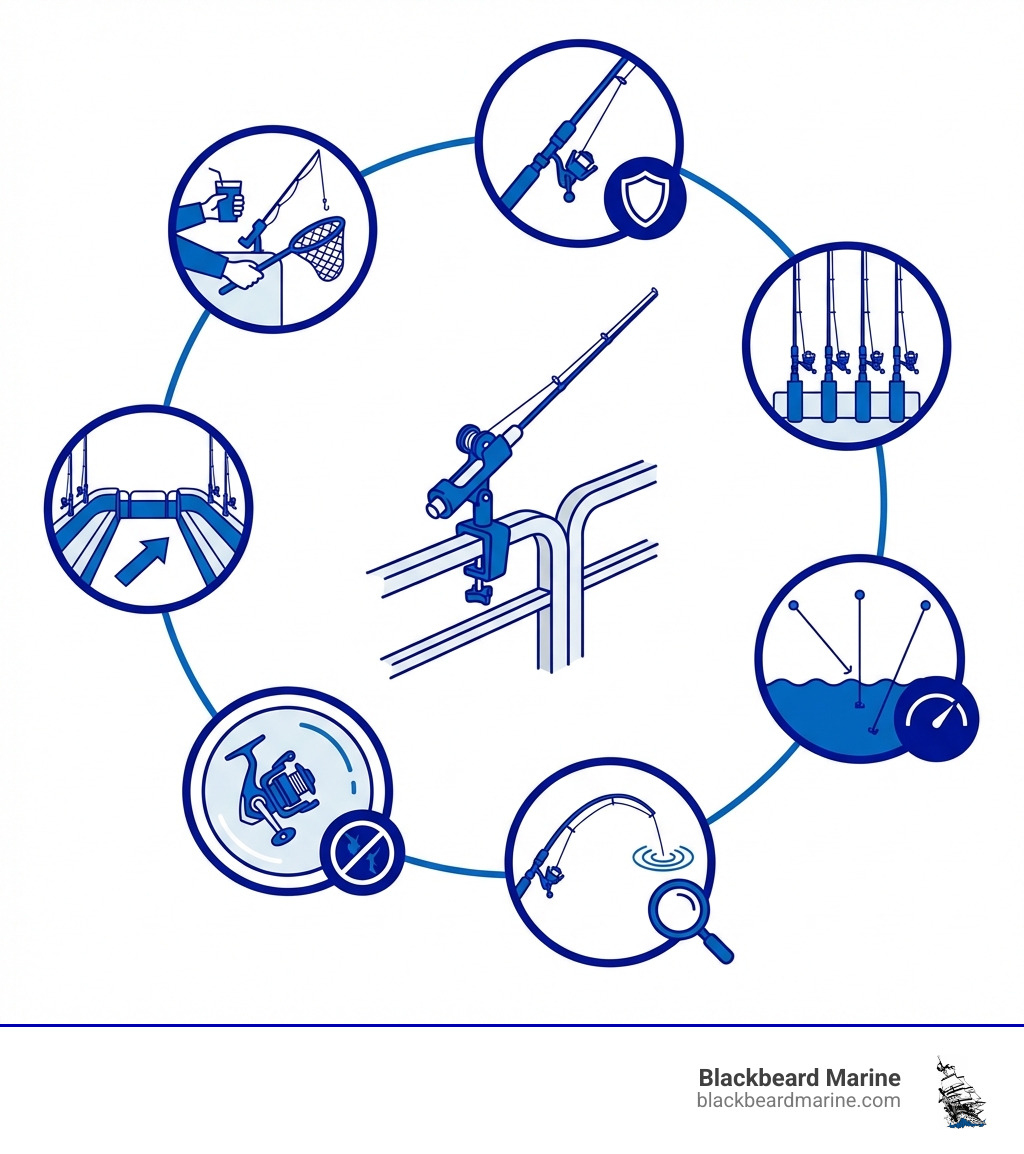
Pontoon boat fishing rod holders are essential accessories that organize your rods, keep them secure while you wait for a bite, and let you run multiple lines at once. The best options for pontoon boats are clamp-on or rail-mount holders that fit standard square rails (typically 1.25″), require no drilling, and feature adjustable angles. Look for stainless steel or anodized aluminum construction for durability, and consider systems that hold 2-4 rods if you fish with family.
Top Rod Holder Types for Pontoons:
- Clamp-On: No drilling required, portable, adjustable positioning
- Square Rail Mount: Secure fit for standard pontoon rails, semi-permanent
- Flush-Mount: Permanent installation, sleek profile, best for dedicated fishing pontoons
- T-Bar Systems: Multiple holders in compact space, ideal for corners
Pontoons are perfect for both family fun and serious fishing around Lake Texoma and Table Rock Lake. But anyone who has tried to manage multiple rods on a pontoon deck knows the frustration—tangled lines, rods underfoot, or worse, a broken rod tip stepped on by a kid running to the bow.
The right rod holders solve all of this. They keep your hands free to net fish, handle the boat, or help a young angler. They organize your fishing station so you can run multiple lines without chaos. And they prevent expensive damage to your gear.
Whether you are trolling for stripers on Lake Texoma, jigging for crappie at Table Rock Lake, or just keeping a few lines out while the family relaxes, rod holders turn your Lowe or Suncatcher pontoon into a true fishing platform. They maximize your deck space, improve your bite detection, and make fishing from a pontoon as effective as it is enjoyable.
The challenge is finding holders that work with pontoon boat rails—especially the common square rails—without drilling holes or causing damage. You need something secure enough to handle a big fish, adjustable enough for different fishing styles, and easy to remove when you want your full deck back for a family outing. For more ideas on turning your pontoon into the ultimate family and fishing machine, check out Pontoon Boat Family Fun.
Decoding the Mounts: Clamp-On vs. Rail vs. Flush-Mount
Choosing the right pontoon boat fishing rod holder often starts with understanding the different mounting types. Each comes with its own set of advantages and considerations, impacting everything from installation to long-term use. We’re looking for solutions that fit seamlessly into our pontoon lifestyle, whether that’s an adventurous fishing trip or a leisurely cruise with the family.
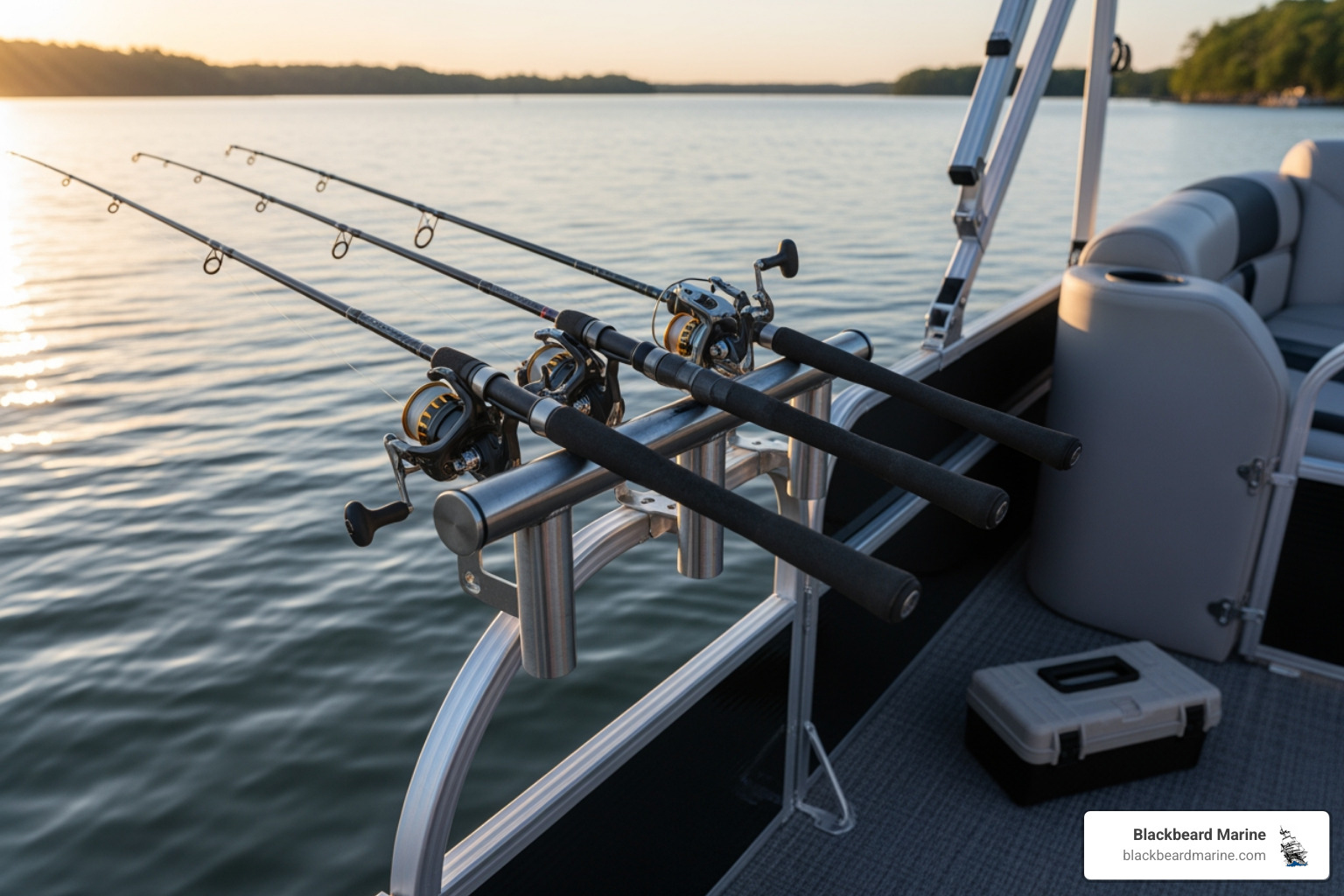
When we consider the layout of a pontoon boat, with its distinct rails and open deck space, certain mounting types naturally stand out. The ease of installation, portability, and how they interact with our boat’s structure are all crucial factors. Let’s explore the specifics:
| Feature | Clamp-On Holders | Rail-Mount Holders | Flush-Mount Holders |
|---|---|---|---|
| Pros | No drilling, highly portable, adjustable, versatile | Secure fit, sturdy, can be adapted for square/round rails | Extremely stable, sleek, integrated look, maximum strength |
| Cons | Can slip if not tightened, less permanent look | May require drilling (depending on type), less portable | Requires drilling, permanent, less flexible placement |
| Best For | Renters, new boat owners, temporary setups | Dedicated anglers, secure long-term use, specific rail types | Custom fishing pontoons, maximum rod security |
| Installation Difficulty | Easy (tool-free or simple tools) | Moderate (may involve drilling) | Advanced (requires precise drilling) |
Clamp-On Rod Holders
When we talk about convenience and flexibility, clamp-on rod holders are often the first solution that comes to mind for a pontoon boat fishing rod holder. They offer a fantastic no-drill solution, which is a huge plus for many pontoon owners, especially those with newer Lowe or Suncatcher models who might want to preserve their boat’s resale value. We simply clamp them onto the existing rails, and we’re ready to go!
Their portability is best. We can move them around the boat as our fishing strategy changes, or easily remove them entirely when we’re switching from fishing to family cruising. This versatility makes them ideal for boat renters or those just starting to outfit their pontoon for fishing. Many clamp-on holders also boast impressive adjustability, allowing us to fine-tune the angle and direction of our rods. The main trade-off? If not tightened securely, they can potentially slip, especially when battling a strong fish.
Rail-Mount Rod Holders
Rail-mount rod holders provide a more secure and integrated fit for our pontoons. These are specifically designed to attach directly to the boat’s rails, whether they’re the common square rails found on most pontoons or the less frequent round rails. For us pontoon owners, especially those with Lowe or Suncatcher boats, finding a rail-mount that specifically accommodates square rails is key.
Some rail-mount options require drilling into the rail for a permanent, rock-solid attachment, while others offer no-drilling solutions using specialized clamps or U-bolts. The choice often depends on our commitment to a permanent fishing setup. We appreciate the stability these mounts offer, particularly when we’re reeling in a big catch on Lake Texoma. It gives us peace of mind knowing our rods are firmly in place. For more ideas on setting up your pontoon for fishing, check out our guide on Pontoon Boat Fishing Setup.
Flush-Mount Rod Holders
For the angler who envisions their pontoon as a dedicated fishing machine, flush-mount rod holders are the ultimate choice. These are permanent installations that integrate seamlessly into the boat’s deck or gunwale, offering a sleek look and maximum stability. Unlike other options, they essentially become part of the boat’s structure.
The trade-off, however, is significant: they require precise drilling into the boat. This means less flexible placement once installed, and it’s a commitment that many pontoon owners might hesitate to make, especially on newer models. But for those who prioritize a clean, integrated aesthetic and uncompromising strength, particularly when targeting larger species or using heavy tackle, flush-mounts deliver. They’re often seen on more specialized fishing vessels, but can be adapted for pontoon boats where the fishing is serious business.
Key Features of the Best Pontoon Boat Fishing Rod Holder
Investing in the right pontoon boat fishing rod holder is more than just buying a piece of equipment; it’s about enhancing our overall fishing experience and ensuring our gear lasts. A well-chosen rod holder can literally be the difference between a successful, stress-free day on the water and a tangled, frustrating mess. Just like we care for our boats, we want our accessories to stand the test of time. For tips on keeping your vessel in top shape, explore our Pontoon Boat Maintenance Tips.
Materials Matter: Durability and Maintenance
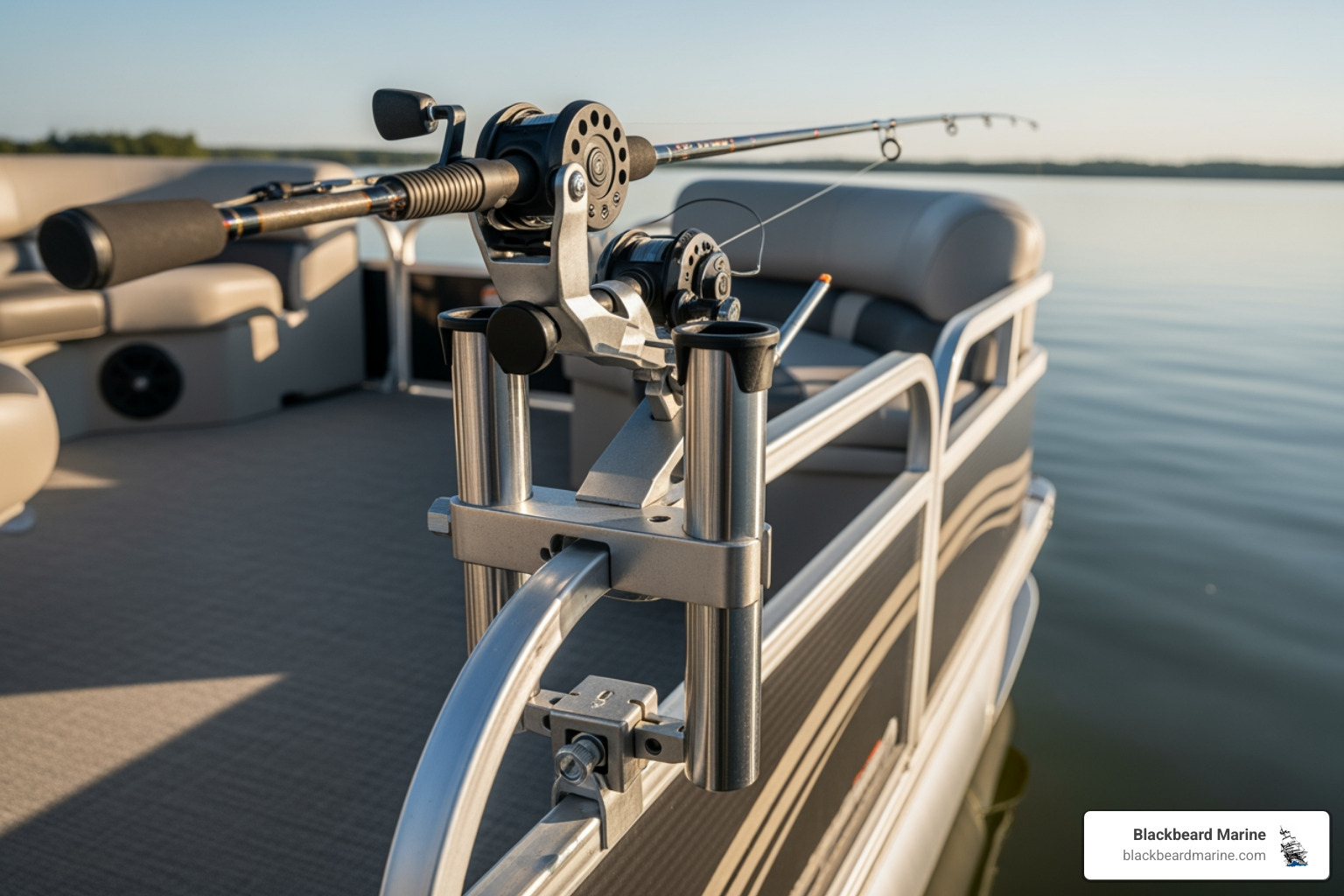
When we consider a pontoon boat fishing rod holder, the material it’s made from is paramount to its longevity and performance. Our boats endure sun, water, and sometimes the occasional thrashing from a determined fish, so our rod holders need to be just as tough.
- Stainless Steel: This is the gold standard for marine applications. It offers excellent corrosion resistance, especially in humid environments or if we venture into brackish waters. While it’s incredibly durable, regular rinsing with fresh water helps maintain its shine and prevents surface rust, especially around bolts and joints.
- Anodized Aluminum: Materials like 6063 T6 aluminum are popular for good reason. Anodizing creates a protective layer that resists corrosion and UV degradation, making it lighter than stainless steel but still very robust. It’s a fantastic choice for freshwater use on Lake Texoma or Table Rock Lake. Maintenance typically involves occasional cleaning with mild soap and water to prevent salt or mineral buildup.
- Heavy-Duty Plastic (Nylon, ABS): For lighter applications or budget-conscious choices, reinforced plastics offer good resistance to UV rays and are completely rust-proof. They are often found in clamp-on or more basic models. While not as strong as metal for fighting large fish, they’re easy to clean and often require less specific maintenance.
We want materials that can withstand the elements and the rigors of fishing without constant fuss.
The Advantage of Adjustability
Imagine trying to troll for stripers on Lake Texoma with a fixed rod holder, only to realize the angle is all wrong for your lines. That’s where adjustability comes in! A truly great pontoon boat fishing rod holder offers a range of motion that can significantly benefit our angling success.
- 360-Degree Rotation: This feature allows us to point our rods in any direction, crucial for spreading out multiple lines, adapting to changing currents, or targeting fish from different sides of the boat. It’s like having a flexible fishing station that moves with our needs.
- Vertical Angle Adjustment: Being able to tilt our rods up or down helps us control the depth of our lures, keep rod tips clear of the water, or position them perfectly for bite detection. This is particularly useful for different fishing techniques, from still fishing to slow trolling.
Many adjustable holders also incorporate robust locking mechanisms to ensure that once we’ve set the perfect angle, it stays put, even when a big one hits. This versatility is key, allowing for precise positioning to optimize our spread and presentation. You can see an example of this type of product here: Adjustable Fishing Rod Holder.
Capacity and Systems: Your ideal pontoon boat fishing rod holder setup
How many rods do we typically fish with? Are we a solo angler or do we often have the whole family casting lines? The capacity of our pontoon boat fishing rod holder setup is key.
- Single Holders: Great for individual placement, allowing maximum flexibility in distributing rods around the boat. They are easy to add or remove as needed.
- Multi-Rod Racks: These systems, often holding two to four rods, are perfect for creating dedicated fishing stations, perhaps at the stern or bow. They consolidate our gear and make it easier to manage several lines at once.
- T-Bar Systems: For maximizing rod placement in a compact area, especially on pontoon corners, T-bar systems are ingenious. They allow us to spread up to three rod holders within a small footprint, ideal for a wide trolling spread or simply getting more lines in the water without cluttering the deck.
Beyond active fishing, we also need solutions for storing our rods safely when not in use. Some systems are designed not just for holding rods while fishing, but also for secure storage. The Pontoon Boat Fishing Rod Storage Solution is an excellent example, designed to keep up to six rods safely off the floor and out of the way, preventing tangles and breakage. This type of solution can even be stored conveniently under a seat when not needed, maximizing our precious deck space. For more details on this, check out Pontoon Boat Fishing Rod Storage Solution – Pontoon Boat Solutions, LLC (®) .
No-Drill and Square Rail Solutions
One of the most common concerns we hear from pontoon owners at Blackbeard Marine is about drilling holes in their beautiful Lowe or Suncatcher boats. Preserving your boat’s integrity and resale value is important, and thankfully, there are fantastic no-drill solutions for pontoon boat fishing rod holders. These options are particularly relevant for pontoons, which predominantly feature square rails, typically 1.25 inches.
Opting for no-drill rod holders means you can outfit your pontoon for serious fishing without making permanent alterations. This is a huge benefit for maintaining the boat’s condition and ensuring it holds its value over time. For more insights on this, you might find our Pontoon Boat Resale Value Ultimate Guide helpful. Plus, many of these no-drill options are easily removable, allowing you to store them away when you are done fishing, keeping your deck clear for cruising, swimming, or sandbar time on Lake Texoma or Table Rock Lake.
Finding the Perfect Fit for Square Pontoon Rails
The unique square rail design of most pontoon boats means you cannot just grab any rod holder off the shelf. You need solutions specifically engineered for this profile.
- Clamp-On Adapters: These are incredibly popular for their versatility. They typically consist of a robust clamp that secures tightly around the square rail, often with rubberized pads to prevent scratching, and then provide a mounting point for a standard rod holder. They offer a secure fit without the need for drilling.
- U-Bolts for Square Rails: Some rod holder systems use U-bolts that are shaped to fit snugly around square rails. When properly tightened, these offer a very strong and stable connection.
- Dedicated Square Rail Mounts: Several brands offer rod holders with integrated mounts designed specifically for 1.25″ square pontoon rails. These often provide the most streamlined and secure no-drill attachment.
At our Blackbeard Marine locations near Lake Texoma and in Branson, MO, we regularly help Suncatcher and Lowe pontoon owners choose rail systems that have proven themselves capable of handling tough fish without compromising the boat’s structure.
Key Features to Look for in a Square Rail Mount:
- Specific Rail Size Compatibility: Ensure it is designed for 1.25″ square rails, which is standard for most pontoons.
- Strong Clamping Mechanism: Look for heavy-duty bolts and large clamping surfaces to prevent slipping.
- Protective Padding: Rubber or plastic inserts help prevent scratches and provide a tighter grip.
- Material Durability: Anodized aluminum or stainless steel will offer the best longevity in marine environments.
- Adjustability: Even with a secure mount, the ability to adjust the rod holder’s angle is a big plus.
Removable Rod Holders for Easy Storage
Pontoon boats are often multi-purpose vessels, transitioning from fishing platforms to party boats in the blink of an eye. This makes removable rod holders an invaluable feature.
- Quick-Release Mechanisms: Many systems incorporate quick-release bases or clamps, allowing you to pop off the rod holder with minimal effort. This means you can clear the deck quickly when it is time for swimming or lounging.
- Storing Under Seats: As mentioned with the Pontoon Boat Fishing Rod Storage Solution, many removable holders and storage racks are designed to fit neatly under pontoon seats. This keeps them out of the way, protected from the elements, and helps prevent theft when the boat is docked.
- Maximizing Deck Space: The ability to remove and store rod holders means you regain full use of your deck space. No more tripping over forgotten rods or having them interfere with your boat cover. It is about having the best of both worlds: a fully equipped fishing boat when you need it, and a wide-open recreational platform when you do not.
Strategic Placement for Optimal Fishing
Placing your pontoon boat fishing rod holders is not just about finding an empty spot; it is a strategic decision that can significantly impact your fishing success and overall enjoyment. You want to maximize your fishing potential while maintaining clear walkways and avoiding interference with other boat features, like the Bimini top or trolling motor.
A well-organized setup means you can move freely, respond quickly to bites, and keep your lines clear. This is especially important on a pontoon, which has a wide-open deck. For those looking to optimize their Suncatcher or Lowe pontoon for fishing, exploring options like those found in our Best Pontoon Fishing Boats For Sale can provide inspiration for integrated designs you can see in person at Lake Texoma or Branson, MO.
How Many Rod Holders Do You Need?
The right number depends on a few factors:
- Solo Angler: For a single angler, two to four rod holders might be sufficient. This allows for one rod in hand and a couple of others soaking bait or trolling.
- Fishing with Family/Friends: If you are often fishing with others, you will want enough holders for everyone to have at least one rod, plus a few extra for spares or different presentations. Multi-rod racks or T-bar systems become very useful here.
- Type of Fishing: Trolling on Lake Texoma often benefits from more lines in the water, suggesting a higher number of holders. Still fishing for crappie on Table Rock Lake might require fewer, but strategically placed, holders.
- Local Regulations: Always double-check local fishing regulations regarding the number of lines permitted per angler.
- Start Small, Expand Later: It is often best to start with a few well-placed holders and add more as your needs evolve. Many clamp-on and rail-mount systems make this easy.
Where to Mount Rod Holders on Your Pontoon
The beauty of a pontoon boat is its spaciousness, but that also means you have many options for placement. Here are some prime spots and considerations:
- Corners for a Wide Spread: Mounting rod holders on the bow and stern corners is excellent for creating a wide spread, especially when trolling. This helps prevent lines from tangling and covers more water.
- Stern for Trolling: The stern is a classic location for trolling rod holders. They keep lines behind the boat and provide a clear view of the rod tips. If you have a ski tow bar, that can also be an excellent, sturdy mounting point for multiple holders.
- Near Fishing Seats: If your pontoon has dedicated fishing seats, placing holders within easy reach is crucial. This allows for quick grabs when a fish strikes.
- Avoiding Walkways: It is essential to keep main walkways clear to prevent trips and allow easy movement around the boat. You want your fishing experience to be fun, not an obstacle course.
- Bimini Top Clearance: Always consider the Bimini top. You want your rod tips to be clear when the top is up, and you certainly do not want them interfering when you fold it down. Adjustable rod holders are particularly helpful here.
- Trolling Motor Path: If you use a bow-mounted trolling motor, ensure rod holders do not obstruct its deployment or operation.
- Boat Cover Fit: Lastly, remember how rod holders might affect the fit of your boat cover. Removable options are perfect for this, allowing you to keep the cover snug and protected while your Suncatcher or Lowe sits at the dock or in storage.
Frequently Asked Questions about Pontoon Rod Holders
What is the price range for pontoon boat fishing rod holders?
While we can’t give specific pricing here, the cost of pontoon boat fishing rod holders varies widely based on material, mounting type, brand, and features.
- Entry-level options, often made of heavy-duty plastic or basic aluminum, are typically more affordable. These are great for casual fishing or if we’re just starting to outfit our pontoon.
- Mid-range holders, usually constructed from anodized aluminum or basic stainless steel, offer a good balance of durability and features. This category often includes adjustable clamp-on or rail-mount options.
- High-end systems and multi-rod racks, such as T-bar setups or robust stainless steel units, represent a greater investment. Their higher cost is justified by superior materials, advanced adjustability (like 360-degree rotation), integrated features, and exceptional strength designed for serious angling.
The features that justify higher costs generally include marine-grade materials (like 6063 T6 anodized aluminum or 316 stainless steel), sophisticated adjustability, quick-release mechanisms, and robust designs capable of handling larger fish.
Can rail-mounted holders handle large fish like catfish or stripers?
Absolutely! With the proper selection and installation, rail-mounted pontoon boat fishing rod holders are more than capable of handling large, powerful fish like catfish or stripers that we might encounter in Lake Texoma or other big waters.
The key is to choose heavy-duty models made from strong materials like anodized aluminum or stainless steel. Forum discussions among experienced anglers frequently recommend heavy-duty brands known for their robustness, specifically for battling large catfish. These types of holders often feature thicker shafts and stronger mounting systems.
Secure mounting is paramount. Whether using clamp-on adapters or U-bolts, ensuring the holder is tightly affixed to a strong section of the pontoon rail is critical. We also need to consider the strength of the pontoon rail itself; while generally sturdy, extreme leverage from a truly massive fish could potentially strain a weaker rail if the holder isn’t distributed properly. Many anglers attest to successfully landing 50+ pound fish with well-chosen and securely mounted rail holders.
How do pontoon rod holders compare to those on other types of boats?
Pontoon boat fishing rod holders have some distinct characteristics compared to those used on other types of fishing boats, largely due to the unique design of a pontoon.
- Emphasis on Rail Mounting: Pontoons feature prominent perimeter rails, making rail-mount and clamp-on holders the most popular and practical choices. Unlike V-hull boats where gunwales might be narrower or less accessible, pontoon rails provide an ideal attachment point.
- Less Emphasis on Flush Mounts: While flush-mounts are common on offshore fishing boats or bass boats for their sleek, integrated look, they are less prevalent on pontoons. This is primarily because drilling into the deck of a pontoon is often undesirable for aesthetic reasons, maintaining resale value, and the fact that the deck might be softer or less structural than a fiberglass hull.
- Designed for Comfort and Versatility: Pontoon rod holders often prioritize ease of use, adjustability, and removability to match the multi-purpose nature of the boat. They are designed to complement the wider, more stable platform of a pontoon, allowing for more spread-out fishing without feeling cramped.
- Square Rail Specifics: The prevalence of square rails on pontoons means many rod holders are specifically designed with square-rail adapters, a feature less common for other boat types that typically have round tubing or flat gunwales.
Overall, pontoon rod holders are custom to leverage the unique structure and spaciousness of a pontoon, providing flexible and often non-permanent solutions that improve the fishing experience without compromising the boat’s primary function as a versatile recreational vessel.
Conclusion: Rig Your Pontoon for Success
Equipping our pontoon with the right pontoon boat fishing rod holder is a game-changer. It transforms our versatile vessel into an even more capable fishing machine, allowing us to enjoy the best of both worlds – family fun and serious angling. We’ve explored the different types of mounts, from the flexible clamp-on options perfect for new boat owners to the robust rail-mounts that stand up to the biggest fish, and even the sleek, integrated flush-mounts for dedicated anglers.
Remember to consider the material for durability, prioritize adjustability for maximum versatility, and choose a capacity that matches your fishing style. Whether you prefer no-drill solutions to preserve your Lowe or Suncatcher pontoon’s pristine condition, or you’re seeking a sturdy setup for battling big catches on Lake Texoma, there’s a perfect pontoon boat fishing rod holder waiting for you.
By thoughtfully selecting and strategically placing your rod holders, you’ll improve safety, optimize your fishing spread, protect your valuable gear, and ultimately, lift every fishing trip. Get ready to cast your lines with confidence and enjoy the thrill of the catch!
Ready to find the perfect fishing pontoon for your new rod holders? Explore our inventory!
