Why Boat Loan Terms Matter More Than You Think
Your boat loan terms dictate your monthly payment, the length of your loan, and the total interest you’ll pay. Understanding these terms is a critical financial decision, similar to a car loan or mortgage but with unique aspects for marine financing.
Key Boat Loan Term Facts:
- Typical Range: Most boat loans last between 10-20 years (120-240 months).
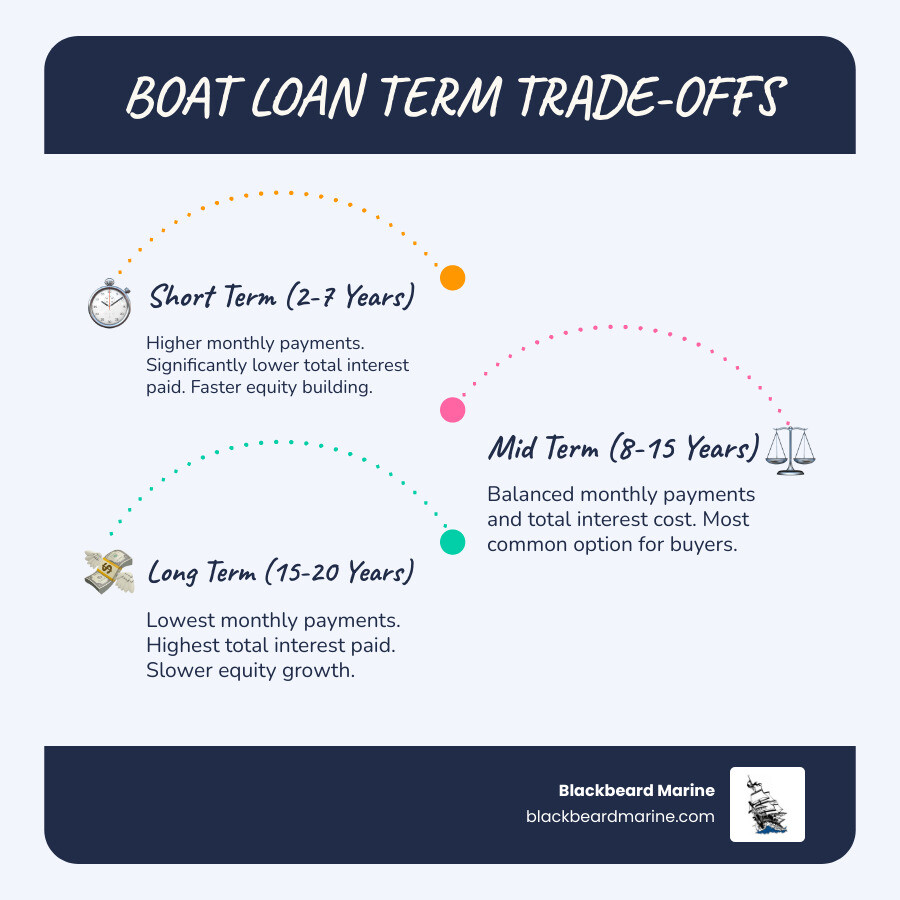
- Short-Term Loans: 2-7 years offer higher monthly payments but lower total interest.
- Mid-Range Loans: 8-15 years provide balanced payments and are a common choice.
- Long-Term Loans: 15-20 years give the lowest monthly payments but the highest total interest cost.
- New vs. Used: New boats can qualify for longer terms (up to 20 years), while used boats typically max out at 10-15 years.
The loan term – the length of time you have to repay – directly impacts your monthly payment, how quickly you build equity, and the total interest you’ll pay. A longer term means smaller monthly payments but more total interest over time. A shorter term has higher payments, but you’ll own your boat sooner and save significantly on interest.
For families looking to enjoy Lake Texoma or Table Rock Lake in boats from trusted brands like Suncatcher, G3, Lowe, SeaArk, Skeeter, or Blazer Bay, understanding these trade-offs helps you make a choice that fits both your budget and your boating lifestyle. Shoppers visiting Blackbeard Marine in Kingston, OK, or Branson, MO, can review real payment examples on specific in-stock boats to see how different terms would affect their budget.
Key boat loan terms vocabulary:
Understanding the Spectrum of Boat Loan Terms
When we talk about boat loan terms, we’re referring to the duration over which you agree to repay the loan. This period can range from a few years to two decades, depending on the loan amount, the boat’s age, and your credit. Understanding these ranges is crucial because it directly impacts your monthly budget and the overall cost of your boat.
As marine engineering has advanced, modern boats from reputable brands like G3 and Lowe are built to last and retain their value. This has allowed lenders to extend boat loan terms, making ownership more accessible. Today, it’s common to find financing options up to 20 years for new vessels.
Let’s explore the typical categories of boat loan terms:
Short-Term Loans (2-7 Years)
Short-term loans (24 to 84 months) are for those who want to pay off their boat quickly and minimize interest. While being debt-free sooner is appealing, these loans come with significantly higher monthly payments.
- Pros: Lower total interest paid, faster equity building, and you own the boat sooner.
- Cons: Higher monthly payments require a stable and higher disposable income.
- Best For: Buyers with a strong income who prioritize minimizing total cost. They are also a smart choice for financing a used boat like a well-maintained SeaArk or Lowe.
Mid-Range Loans (8-15 Years)
Mid-range terms (96 to 180 months) strike a popular balance between manageable payments and reasonable interest costs. This is often the sweet spot for many boat buyers.
- Pros: A balance of affordability and total cost, making them the most common option.
- Cons: Equity builds more slowly compared to a short-term loan.
- Best For: Financing new pontoon boats like a Suncatcher or fishing boats like a G3, SeaArk, or Lowe. They allow you to spread the cost over a period that aligns with typical ownership cycles, letting you enjoy Lake Texoma or Table Rock Lake without overwhelming payments.
Long-Term Loans (15-20 Years)
Long-term loans (180 to 240 months) are typically reserved for higher-value vessels or for buyers who prioritize the lowest possible monthly payment.
- Pros: The lowest monthly payments, making more expensive boats like a high-performance Skeeter bass boat or a large Suncatcher pontoon more accessible.
- Cons: The highest total interest cost and very slow equity building, which increases the risk of being “upside down” (owing more than the boat is worth).
- Best For: Financing high-value new boats for buyers committed to long-term ownership and for whom monthly cash flow is a top priority.
To illustrate, here is a comparison of a $50,000 loan at an 8% interest rate over different terms:
| Term (Years) | Monthly Payment (Approx.) | Total Cost (Approx.) | Total Interest Paid (Approx.) |
|---|---|---|---|
| 5 | $1,014 | $60,829 | $10,829 |
| 10 | $607 | $72,797 | $22,797 |
| 20 | $418 | $100,373 | $50,373 |
Calculations are approximate and for illustrative purposes only. Actual offers available through Blackbeard Marine’s lender partners in Kingston, OK, and Branson, MO, will vary based on your profile and the specific boat you choose.
This table clearly shows the dramatic difference in total interest paid, even though the lower monthly payment of a longer term seems attractive at first glance.
The Financial Impact of Your Chosen Loan Term
Choosing your boat loan terms has profound financial implications that affect your budget and the total cost of ownership. The length of your loan directly influences your monthly payment and the total interest you’ll pay.
Most marine loans, like those for Blazer Bay fishing boats or Suncatcher pontoons, use simple interest and a fixed rate. Your interest rate will not change, and payments are typically amortized. This means early in the loan, more of your payment goes to interest, while later, more goes toward the principal balance.
How Loan Terms Affect Your Monthly Payment
The relationship is simple: the longer the term, the lower your monthly payment. This is because the loan is spread over more payments.
For example, financing a $30,000 G3 fishing boat at 7% interest:
- A 5-year term would have a monthly payment of around $594.
- A 10-year term drops the payment to approximately $348.
That difference of nearly $250 per month provides significant breathing room in your budget for enjoying your time on Lake Texoma or Table Rock Lake. However, this immediate relief has a long-term cost.
How Loan Terms Affect Total Interest Paid
While longer terms offer lower monthly payments, they lead to a substantial increase in the total interest paid. This is the core trade-off many buyers overlook.
Using the $30,000 G3 boat example at 7% interest:
- The 5-year term results in about $5,640 in total interest.
- The 10-year term results in roughly $11,760 in total interest.
That is an extra $6,120 paid for the convenience of a lower monthly payment. It is crucial to be aware of these long-term financial implications when choosing your boat loan terms.
The Connection Between Interest Rates and Your Boat Loan Terms
It is a common myth that longer boat loan terms automatically mean much higher interest rates. While some lenders might add a slight premium for very long terms, the primary factor determining your interest rate is your credit score.
Lenders see shorter loans as less risky, so borrowers with excellent credit might find slightly better rates on shorter terms. However, your credit score is the main driver. A borrower with a 750+ score will almost always get a better rate on any term length than someone with a score in the mid-600s.
If you’re concerned about your credit, Blackbeard Marine works with a range of lenders who can review your situation and explain your options. You can also learn more here: More info about bad credit boat loans.
Key Factors That Influence Your Available Boat Loan Terms
Lenders assess several factors about the boat and your finances to determine your available boat loan terms. Understanding these factors can help you prepare and secure the most favorable terms for your dream vessel, whether it’s a new Skeeter bass boat or a family-friendly Lowe pontoon.
Lenders use a set of criteria to evaluate the risk associated with a boat loan, which helps them determine the loan term, interest rate, and down payment. It is similar to a personal installment loan but with a physical asset involved. To learn more about personal installment loans in general, check out this resource: What Is A Personal Installment Loan?.
The Boat Itself: Age, Value, and Type
The boat you choose plays a significant role in the boat loan terms you’re offered.
- New vs. Used Boats: New boats (0-5 years old) generally qualify for the longest terms, often up to 20 years. Used boats have shorter maximum terms. A boat that is 6-10 years old might qualify for a 10-15 year term, while an older boat (11-20 years) may be limited to 7-10 years.
- Loan Amount: Larger loan amounts often qualify for longer boat loan terms, as lenders may have minimum thresholds for extended periods.
- Boat Type and Brand Reputation: Well-regarded brands like Suncatcher, G3, Lowe, SeaArk, Skeeter, and Blazer Bay often receive more favorable financing terms due to their proven durability and resale value. A lender is more comfortable offering a longer term on a boat that holds its value well.
- Loan-to-Value (LTV) Ratio: This is the ratio of the loan amount to the boat’s value. A lower LTV (from a larger down payment) signals less risk and can open up better boat loan terms.
Your Financial Profile: Credit Score and Down Payment
Your personal financial health is one of the most critical factors influencing your boat loan terms.
- Credit Score Importance: A high credit score (700+) indicates lower risk and makes you eligible for the best interest rates and terms. A minimum score of around 600 is often required for a traditional boat loan.
- Down Payment Effect: A substantial down payment (typically 10-20%) is one of the best ways to improve your loan terms. It reduces the loan amount, lowers the lender’s risk, and can lead to better rates or longer terms.
- Reducing Lender Risk: Lenders also consider your debt-to-income (DTI) ratio. A lower DTI shows you can comfortably manage new boat payments.
Lender Policies and Options
Different lenders have different policies, so it’s key to explore your options.
- Banks vs. Credit Unions vs. Marine Lenders: Banks, credit unions, and specialized marine lenders all offer financing. Marine lenders often have a deeper understanding of the market, which can lead to more flexible boat loan terms.
- Dealership Financing Convenience: Many dealerships, including Blackbeard Marine in Kingston, OK, and Branson, MO, offer convenient financing through partnerships with various lenders. This can streamline the process and provide access to special promotions, especially for buyers looking to enjoy Lake Texoma or Table Rock Lake. Learn more here: Boat Financing Options Guide 2025.
Choosing the Right Term for Your Boating Lifestyle
Selecting the perfect boat loan terms is a personal decision that aligns your finances with your dreams of being on the water. Whether you’re planning fishing trips on Lake Texoma in a SeaArk or enjoying Table Rock Lake from Branson, MO, the term you choose will shape your ownership experience.
Blackbeard Marine’s team is available to help you make an informed decision that keeps your boating journey smooth from day one.
Aligning Your Term with Your Financial Situation
Start with a candid assessment of your finances, looking beyond just the monthly payment.
- Assess Your Monthly Budget: How much can you comfortably afford? Many buyers aim to keep total boat-related expenses (loan, insurance, maintenance) under 10-15% of their gross monthly income.
- Consider Income Stability: Is your career stable? If your income is likely to increase, you have more flexibility. If you’re nearing retirement, a lower payment from a longer term might offer more security.
- Total Cost of Ownership: Remember to budget for insurance, maintenance (even for durable brands like Lowe, G3, and SeaArk), storage, fuel, and accessories.
Matching the Term to Your Ownership Plans
Your long-term intentions for the boat should heavily influence your choice of boat loan terms.
- How Long You Plan to Keep the Boat: If you plan to keep your G3, Skeeter, or Suncatcher for many years, a longer term might make sense to keep payments low.
- Upgrading Frequently: If you love to upgrade every few years (for example, moving from a versatile Blazer Bay to a dedicated Skeeter tournament rig), a shorter loan term is better. It helps you build equity faster and reduces the risk of being in a negative equity position.
- Understanding Boat Depreciation: New boats can lose 20-30% of their value in the first few years. High-quality brands like Skeeter, Blazer Bay, and Suncatcher tend to hold their value better, but depreciation is still a reality.
- Avoiding Being ‘Upside Down’: This happens when your loan balance is higher than the boat’s market value. Longer boat loan terms and small down payments increase this risk. A shorter term and larger down payment help you avoid this.
Can You Negotiate Your Boat Loan Terms?
While you cannot always negotiate the loan’s core structure, you can influence the outcome.
- Improving Your Credit Score: This is your most powerful tool for getting better rates and terms.
- Larger Down Payment: A bigger down payment reduces the lender’s risk and often results in better terms.
- Shopping Around: Compare offers from multiple lenders to find the best deal.
- Discussing Options with a Finance Expert: Finance experts at Blackbeard Marine in Kingston, OK, and Branson, MO, can help you explore scenarios and guide you toward the best boat loan terms for your needs, whether you plan to spend weekends on Lake Texoma or cruise Table Rock Lake with family and friends.
Frequently Asked Questions about Boat Loans
We know that understanding boat loan terms can bring up a lot of questions. Here are some of the most common inquiries we hear, with clear answers to help guide your financing journey.
What is the longest loan term you can get for a boat?
The longest boat loan terms are typically 20 years (240 months). This is usually reserved for new, high-value boats from reputable brands like Skeeter or Suncatcher, and for highly qualified buyers. For used boats, terms are shorter, often maxing out at 10-15 years, depending on the boat’s age and value.
Can I pay off my boat loan early?
Yes, in most cases. The vast majority of marine loans are simple interest loans, which means you can pay them off early without a prepayment penalty. Making extra payments reduces the principal faster and saves you money on total interest. However, it’s always wise to confirm the specific terms with your lender before signing.
How old of a boat can you finance?
This varies by lender, but many traditional marine lenders will not finance boats older than 15-20 years. Older boats that do qualify for financing, such as a 15-year-old SeaArk fishing boat, typically come with shorter loan terms and potentially higher interest rates. This is because they are seen as a higher risk due to increased maintenance needs and depreciation.
Conclusion: Setting Sail with the Perfect Loan
Choosing the right boat loan terms is a crucial step in making your boating dreams a reality. It is a decision that balances your immediate desire for affordable monthly payments with your long-term financial health and overall cost of boat ownership. We have explored the spectrum of short, mid-range, and long-term loans, understanding how each impacts your budget, total interest paid, and equity building.
The best term is not a one-size-fits-all solution; it is the one that fits your unique financial situation, the specific boat you’re purchasing, and your personal boating goals. Whether you’re eyeing a new Skeeter bass boat for tournament fishing, a Blazer Bay for inshore versatility, or a family-friendly Suncatcher or Lowe pontoon for leisurely cruises on Lake Texoma or Table Rock Lake, a thoughtful approach to financing will help keep your time on the water stress-free.
At Blackbeard Marine in Kingston, OK, and Branson, MO, the team understands the excitement and the considerations that come with buying a boat. Their finance experts are dedicated to helping buyers in Oklahoma and Missouri review their options, providing clear guidance and flexible financing solutions. They can walk you through the nuances of boat loan terms on actual in-stock models so you can confidently set sail with a payment plan that works for you.
Ready to explore your options and find the perfect boat with the ideal financing?