
Why Understanding Your Pontoon Trade-In Value Matters
Pontoon trade in value is the estimated worth a dealer will offer for your current pontoon when you’re upgrading to a new boat. Understanding this value is key to a successful trade-in. Here’s a quick overview:
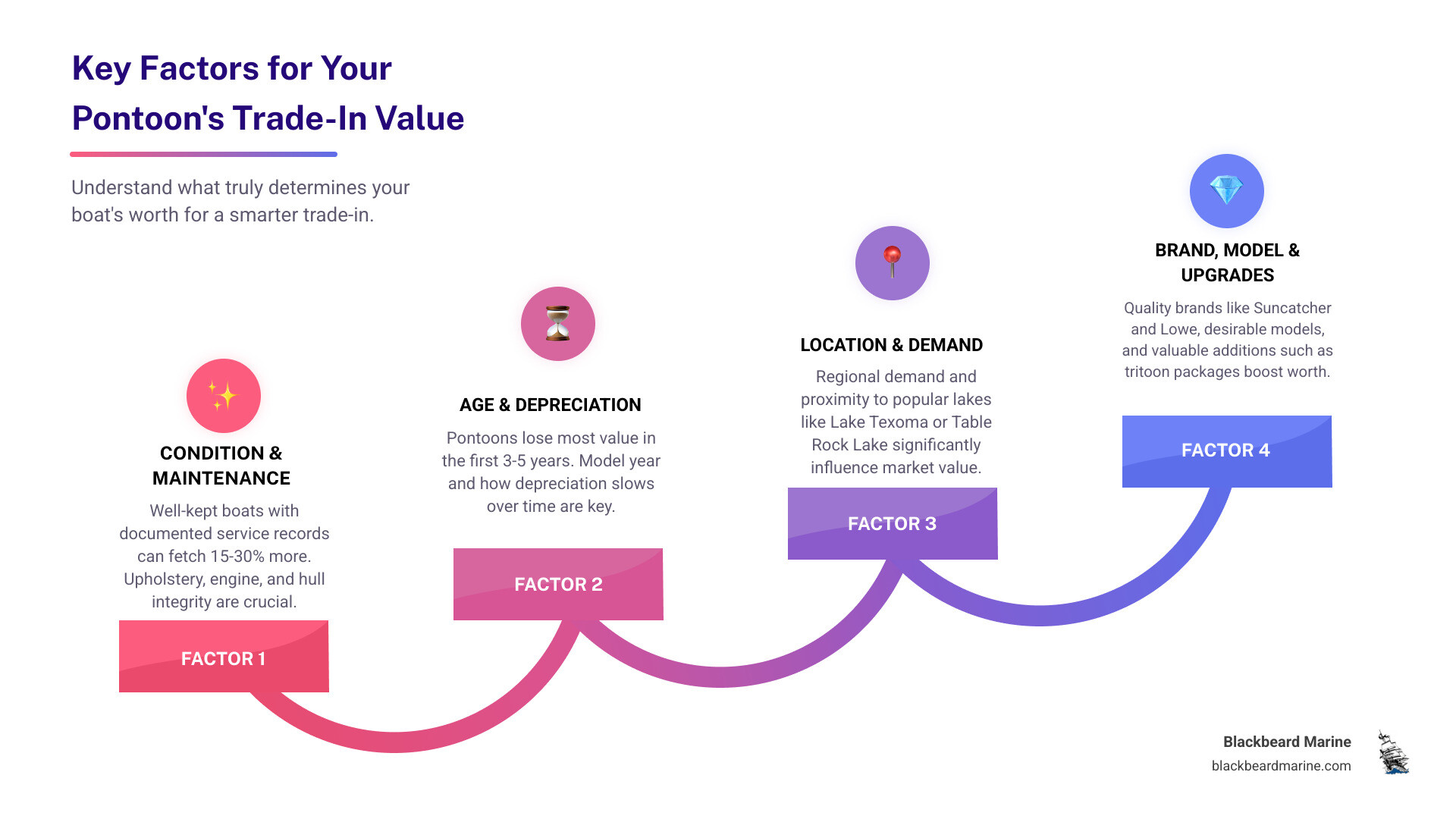
Quick Answer: What Determines Your Pontoon Trade-In Value
- Condition & Maintenance: Well-maintained boats with service records fetch 15-30% more.
- Age & Depreciation: Value drops most in the first 3-5 years, then depreciation slows.
- Location & Demand: Pontoons near popular lakes like Lake Texoma or Table Rock Lake hold higher values.
- Brand & Model: Quality brands like Suncatcher and Lowe retain value better.
- Upgrades: Upgraded engines, premium electronics, and tritoon packages increase worth.
Whether your family has outgrown your current boat or you’re ready to upgrade to a new Suncatcher or Lowe pontoon, the big question is: What’s your current boat actually worth?
Unlike cars, a pontoon’s value isn’t based on a simple formula. It depends on numerous factors many owners overlook. By understanding these factors, you gain control of the trade-in process. Walking into our Lake Texoma or Branson locations prepared allows you to negotiate from a position of knowledge, avoid a low offer, and potentially add thousands to your trade-in value.
This guide breaks down everything that affects your pontoon’s worth, showing you how to calculate a realistic value and maximize your offer.
Key Factors That Determine Your Pontoon’s Worth
Your pontoon boat is an investment that changes value over time, but not in the same way as a car. Your pontoon trade in value depends on a unique mix of factors. The good news is that pontoons hold their value well due to their popularity. However, a true assessment goes beyond year and model to include its physical condition, usage, storage, and any improvements. For quality brands like Suncatcher and Lowe, these details can mean the difference between a disappointing offer and a great trade-in value. Let’s break down what really matters.
The Critical Role of Condition and Maintenance
Condition is the most critical factor for your pontoon trade in value. A well-maintained boat will always command a higher price than a neglected one. Buyers and dealers are immediately drawn to a boat that looks cared for. Regular maintenance preserves the structural integrity and functionality that buyers pay for.
Key areas of inspection include:
- Upholstery: Clean, intact seats without tears, fading, or mildew signal a well-loved boat.
- Decking: Solid, clean flooring without soft spots gives buyers confidence.
- Pontoon Tubes: Dents, scrapes, or corrosion on the tubes are major red flags, as repairs are costly.
- Engine: Low engine hours combined with documented service records significantly boost value.
- Canvas and Covers: Well-maintained covers show you’ve protected your investment from the elements.
- Electrical Systems: All lights, gauges, and accessories should work properly to avoid suggesting deeper neglect.
The difference between a well-maintained pontoon and a neglected one can easily be 15-30% in trade-in value. If your boat needs some TLC, our Boat Maintenance Services can help get it in top shape.

Age and Depreciation: The Inevitable Curve
All boats depreciate, but it’s not a straight line down. Pontoons experience their steepest value drop during the first 3-5 years as the “new boat” premium disappears. After this initial period, depreciation slows down considerably. A seven-year-old pontoon might lose only a fraction of what it lost in its second year. Timing your trade-in can help maximize your return.
The model year is important, but some designs age better than others. This is where brands like Suncatcher and Lowe shine. Their reputation for quality construction and timeless design means their boats often defy typical depreciation trends. A well-maintained, older Suncatcher or Lowe can still command a strong price because buyers trust the brand’s durability. This trust translates directly into better resale values. For more insights, check out our Pontoon Boat Buying Guide.
How Location and Market Demand Play a Part
Where you keep your pontoon significantly affects its worth. Local market demand and the length of the boating season can swing your pontoon trade in value by thousands.
In thriving boating destinations like our locations near Lake Texoma and Table Rock Lake, quality pontoons are in high demand. More buyers mean higher values. In contrast, an area with a short season or limited water access will have lower demand and lower offers.
Furthermore, freshwater boats, like those used on our local lakes, command higher values than saltwater-exposed boats. Saltwater accelerates corrosion on metal, wiring, and engines, a fact that savvy buyers know well.
Our team at Blackbeard Marine understands the local market dynamics in Kingston, OK, and Branson, MO. This expertise ensures you get an appraisal reflecting real market conditions, not just national averages. See what’s popular by browsing our Pontoon Boats For Sale Kissee Mills MO inventory.
The Value of Upgrades and Customizations
Not all upgrades are created equal. Desirable upgrades that appeal to a wide range of buyers can increase your pontoon trade in value, while highly personal modifications may not add any value.
Upgrades that typically pay off include:
- Engine Upgrades: More powerful or fuel-efficient motors are almost always a plus.
- High-End Electronics: Modern GPS, fish finders, and depth sounders add serious appeal.
- Premium Sound Systems: A great stereo is a crowd-pleaser on the water.
- Upgraded Flooring: Woven vinyl is a significant improvement over worn carpeting.
- Performance Packages: Tritoons, lifting strakes, and hydraulic steering dramatically improve handling and versatility, adding significant value.
On the other hand, personal touches like custom lighting or unique paint schemes can be a turnoff for buyers and may not increase your trade-in offer. Stick to upgrades that improve comfort, performance, and safety for the average boater. Explore popular additions in our Lowe Pontoon Boat Accessories section to see what buyers value.
How to Calculate Your Pontoon Trade In Value
Now for the practical part: figuring out what number to expect. Calculating your pontoon trade in value is a two-step process: get a general idea with online tools, then get a firm number with a professional appraisal. Setting realistic expectations from the start is key to a smooth process as you plan your upgrade to a new Suncatcher or Lowe pontoon.
Using Online Valuation Guides
Online valuation tools like NADA Guides (now part of J.D. Power) are a great starting point. They use national sales data to provide average values based on your boat’s make, model, year, and features. When using these tools, be precise with your details to get the most accurate range.
However, these guides provide average values and can’t account for local market factors, like the high demand for pontoons around Lake Texoma or Table Rock Lake. They also don’t know your boat’s specific condition or maintenance history. For this reason, they provide a ballpark figure, not a final offer. For more on boat pricing, you can reference Boat Prices with NADA Guides.
Why a Professional Dealer Appraisal is Crucial
A professional dealer appraisal from Blackbeard Marine provides the real number for your trade-in. Our team brings local market expertise that online calculators lack. We know what buyers in Kingston, OK, and Branson, MO, are looking for and what they’re willing to pay for a quality Suncatcher or Lowe pontoon.
An appraisal includes a thorough physical inspection. Our technicians examine the pontoon tubes, deck, engine, upholstery, and electrical systems. This hands-on approach identifies both positive attributes (like an upgraded stereo) and hidden issues (like minor corrosion) that online tools miss.
The result is an accurate, fair trade-in offer based on your boat’s specific condition and our local market. It’s a number you can count on as you look to upgrade to one of our Pontoon Boats For Sale.
Pro Tips: Maximizing Your Pontoon’s Trade-In Value
Once you’ve decided to trade in, you can take steps to maximize your offer. Think of it like staging a house for sale—a little preparation goes a long way. A well-presented Suncatcher or Lowe pontoon tells us you’ve been a conscientious owner. These simple, inexpensive steps can add hundreds or even thousands to your pontoon trade in value.
Deep Clean and Detail for Maximum Appeal
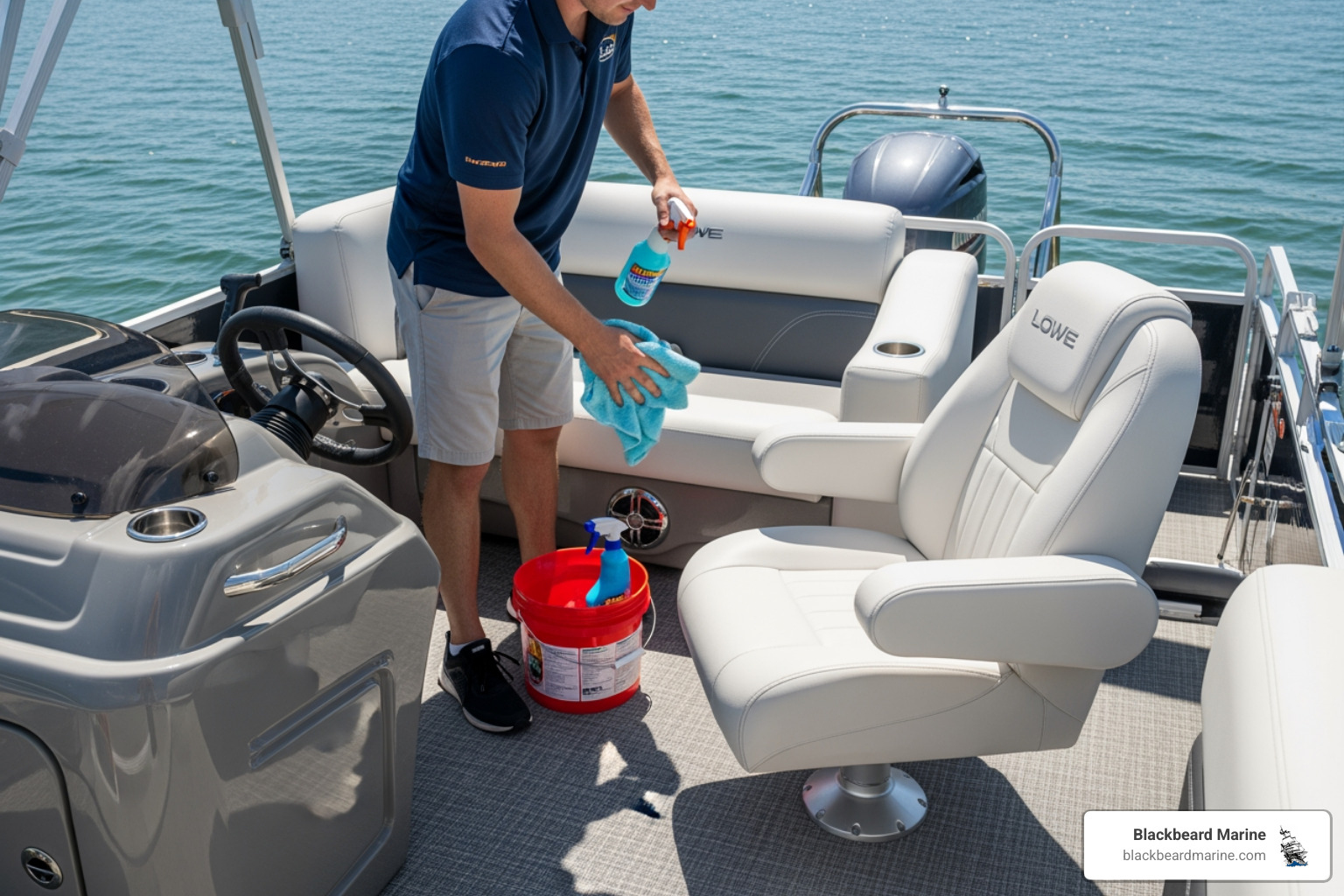
A dirty boat suggests neglect. Before your appraisal, give your pontoon a deep clean to make a great first impression.
- Wash and Wax: Thoroughly wash the exterior, including the hull, pontoons, and railings. Apply a quality marine wax to make the finish shine.
- Detail the Interior: Scrub the upholstery to remove dirt and mildew. Polish all metal components like cleats and railings until they sparkle.
- Declutter: Remove all personal items. You want the dealer to envision the boat with a new owner, not be distracted by your gear.
- Deodorize: Air out the boat and use a marine odor eliminator to remove any musty or fishy smells. A fresh-smelling pontoon signals a well-maintained vessel.
Gather All Your Paperwork and Service Records
Documentation proves responsible ownership and can significantly boost your offer. Gather all your records into a folder to show you’re an organized and serious seller. This simple step sets you apart from most trade-ins.
Be sure to include:
- Title and current registration (essential for the sale).
- Service records, including receipts for oil changes, winterization, and other routine maintenance from places like our Boat Maintenance Services.
- Major repair receipts to prove work was done professionally.
- Warranty documents for any transferable warranties.
- Owner’s manuals for the boat, engine, and electronics.
This paper trail reduces uncertainty for the dealer and directly impacts your pontoon trade in value.
Address Minor Repairs and Fixes
Before the appraisal, inspect your boat for minor issues. Small problems can add up and give a dealer reasons to lower their offer. A $15 burned-out navigation light might signal larger electrical problems, leading to a disproportionate deduction.
Address the easy fixes yourself:
- Tighten loose fittings like railings, cleats, and console components.
- Replace dead bulbs in navigation lights and gauges.
- Test all functions: bilge pump, horn, trim system, and accessories.
- Buff out minor scratches and scuffs on the gel coat or aluminum.
Focus on low-cost fixes that improve the boat’s overall impression. Don’t invest in major repairs like a new engine, as you’re unlikely to recoup the cost. If you need parts for your Yamaha, our Yamaha Outboard Parts department can help. A weekend of small repairs can add hundreds to your final offer.
Trading In vs. Selling Privately: Which is Right for You?
You have two options for your old pontoon: trade it in at a dealer or sell it privately. The right choice depends on your priorities: convenience versus maximum cash. Trading in at Blackbeard Marine is fast and easy, while selling privately may yield more money but requires significant effort. This table breaks down the key differences:
| Feature | Trading In | Selling Privately |
|---|---|---|
| Convenience | High (one-stop transaction) | Low (requires effort, time, and coordination) |
| Price | Typically lower than private sale potential | Potentially higher (you keep the dealer’s margin) |
| Time | Fast (often completed in a single day) | Slow (can take weeks or months to find a buyer) |
| Effort | Minimal (dealer handles everything) | High (marketing, showings, negotiations, paperwork) |
| Paperwork | Dealer handles title transfer, registration, etc. | Your responsibility (title, bill of sale, disclosures) |
| Tax Advantage | Potential sales tax reduction on new purchase | None |
| Safety | Secure transaction with a reputable dealer | Can involve meeting strangers, potential scams |
The Simplicity of a Pontoon Trade In Value
For most boaters, the simplicity of a trade-in is the winning factor. It’s a one-stop transaction: bring your old boat to our Kingston or Branson location and leave with your new Suncatcher or Lowe. There are no advertising costs, no fielding calls from strangers, and no wasted time.
We handle all the complex paperwork, from title transfers to registration. Plus, there’s a significant tax advantage. In many states, you only pay sales tax on the difference between the new boat’s price and your trade-in’s value, which can save you thousands.
Trading in is secure, straightforward, and gets you back on the water faster. Explore financing for your next boat with our guide to the Best Boat Loan Rates.
The Potential of a Private Sale
If maximizing your cash return is the top priority and you have ample time, a private sale is an option. By selling directly, you cut out the dealer and keep the profit margin. You also control the asking price and negotiations.
However, this path requires significant work. You’ll be responsible for:
- Marketing: Taking professional photos and writing compelling ads for sites like the ones on our Websites to Shop for Boats list.
- Showings: Fielding calls and scheduling meetings with potential buyers.
- Negotiations: Dealing with lowball offers and tire-kickers.
- Paperwork: Handling the bill of sale, title transfer, and any disclosures correctly.
- Safety: Meeting strangers and verifying payments securely.
A private sale can take weeks or months, during which you’re still paying for insurance and storage. For many, the convenience of a trade-in outweighs the potential for a slightly higher price.
Frequently Asked Questions about Pontoon Trade-In Values
When it comes to your pontoon’s value, you likely have questions. Having helped countless boaters in the Lake Texoma and Table Rock Lake areas, we’ve compiled answers to some of the most common questions about pontoon trade in value.
How much does a pontoon boat depreciate each year?
There’s no single depreciation number, as it depends on brand, condition, and other factors. However, a general pattern exists:
- Years 1-3: The steepest drop occurs here, often 15-25% in the first year, as the “new boat premium” fades.
- Years 5-10: Depreciation slows considerably, dropping to perhaps 5-10% annually for a well-maintained boat.
- After 10 Years: Value tends to stabilize, especially for popular, well-cared-for models.
A well-maintained Suncatcher or Lowe in a high-demand market like ours will always depreciate slower than a neglected, lesser-known brand.
Does a trailer increase the trade-in value?
Yes, a trailer almost always increases your pontoon trade in value. It solves a major logistical problem for the next owner. The trailer’s condition is assessed just like the boat’s, so its value depends on its age, brand, and state of repair. A well-maintained trailer with good tires, working lights, and sound brakes is a valuable asset. A rusted-out trailer, however, may add little to no value. Ensure your trailer is in good working order before the appraisal.
When is the best time of year to trade in my pontoon?
While your boat’s condition is more important than timing, seasonal trends can play a role in your pontoon trade in value.
- Fall/End of Season: As we prepare for the next season’s inventory, we may be more motivated to offer competitive trade-in deals.
- Spring: Demand for boats peaks, which is great for sellers. If we are low on a specific type of used pontoon, you’ll be in a strong position.
The best time to trade is when a dealer needs what you have. Our inventory needs are the biggest factor. Since we’re always looking for quality used Suncatcher and Lowe pontoons, any time you’re ready to upgrade is a good time to visit us. You can see what’s new in our Best Pontoon Boats 2023 guide.
Get a Fair and Fast Offer for Your Pontoon
You’re now equipped with the knowledge to make an informed decision about your pontoon trade in value. You understand the key factors, from condition to location, and have weighed the pros and cons of trading versus selling privately. Now, it’s time to turn that knowledge into action.
At Blackbeard Marine, we’re your partners in making the upgrade process simple and enjoyable. Our teams at our Kingston, OK (Lake Texoma) and Branson, MO (Table Rock Lake) locations are local market experts. We provide accurate, competitive appraisals that reflect the true worth of your Suncatcher or Lowe pontoon.
The process is straightforward. Visit us, and our technicians will conduct a thorough inspection while you browse our selection of new boats. You’ll receive a firm, fair offer quickly, getting you one step closer to your next adventure.
Ready to find out what your pontoon is really worth? Take the next step with confidence.
For more guidance, see our Pontoon Boat Buying Guide or find us via Our Locations.
